




 By Dr. Peter Pirnejad, ICMA-CM
Executive Director, Davenport Institute for Public Engagement & Civic Leadership · Pepperdine University, School of Public Policy
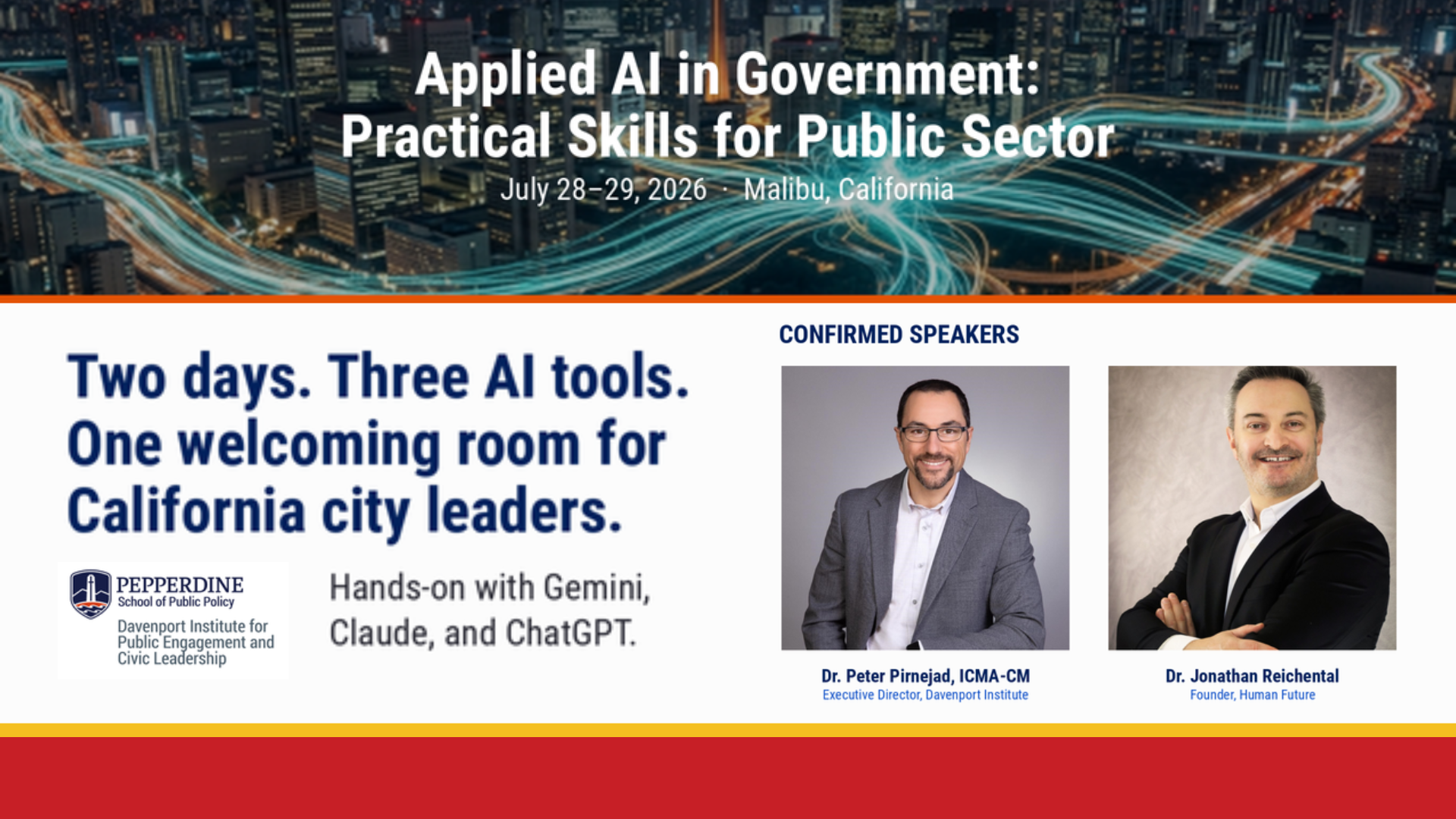
On July 28 and 29, the Davenport Institute at Pepperdine University will host a working cohort of city managers, department heads, and municipal technology leaders for two days of practical, hands-on work with the tools reshaping our profession. I want to invite you into that room, and into a larger conversation about what comes next.
Most local government professionals have now used AI in some form. We have drafted emails with it, summarized long staff reports, or polished communications before sending them out. That is a meaningful start. The opportunity in front of us now is to move beyond casual use and into something more ambitious: treating AI as a thought partner, an administrative assistant, and, frankly, a powerful tool that can help us accelerate our productivity, expand our capacity, and extend our professional capabilities to new heights.
After nearly three decades in California local government, including service as a city manager and as Immediate Past President of Cal-ICMA, I see my role in this encore chapter of my career as a straightforward one: to gather the best thinking I can find from experts across adjacent fields and translate it back into something usable for the public service profession. AI is the clearest example of that work right now.
The opportunity in front of us
The agencies that will get the most out of this moment are the ones that stop thinking of AI as a novelty and start thinking of it as a capability. Used well, these tools expand what a single staff member can responsibly take on. They accelerate research, sharpen written communication, structure analysis, and surface patterns in information we would otherwise process line by line. For organizations that are perpetually asked to do more with less, that is not a small thing. It is a meaningful expansion of professional reach.
This is the framing I would encourage you to carry: AI as a force multiplier for the work you already do well, not a replacement for the judgment that makes you good at it.
But public service is different
Powerful tools carry inherent risks, and in local government those risks are not abstract. We work in the public trust. The credibility of a staff report, a council memo, or a community notice is part of the administrative record that is the foundation of our operating system built on trust and historical archive that will live for ages. When that fabric frays, the cost shows up not in a quarterly report but in eroded confidence that takes years to rebuild.
That is why responsible use matters here in ways it may not in other sectors. Hallucinated facts, fabricated citations, confidential information passed inadvertently into a public model, bias quietly embedded in a recommendation, the gradual drift toward what some have started calling “AI slop” — unreviewed, generic, low-context content pushed out under your name and your agency’s seal. Each of these is a small breach of the trust we are charged with protecting. Together, they are a serious one.
The point is not to be fearful of the tools. The point is to be disciplined with them.
Confidence, clarity, and precision
Here is the standard I would put forward for our profession: any product that leaves your desk should reflect your judgment, your institutional knowledge, your sense of what your council and community actually need to hear. AI can help you get there faster, but it cannot get you there on its own. The model does not know your jurisdiction. It does not know which council member asked the question last month or which neighborhood association is watching this item closely. You do.
Practically, that means vetting what the tool gives you. It means checking citations, testing claims, rewriting passages that sound generic, and removing the connective tissue that makes AI-generated prose recognizable on sight. It means asking, before anything goes out, whether the document represents your best work or merely your fastest. The goal is not speed for its own sake. The goal is high-quality output that builds credibility for you and your organization while letting you meet the goals your agency and community have set.
Put simply: AI should accelerate your expertise, not replace your responsibility.
Bringing your organization with you
The next step, once you have your own footing, is to help the people around you find theirs. The most effective adoption I have seen in cities does not come from a top-down policy roll-out or a vendor demo. It comes from managers and department heads who have done the work themselves, can speak to it credibly, and create the conditions for their teams to experiment responsibly. Peer learning, both inside an organization and across the profession, has always been how local government has matured its practice. AI is no exception.
That is the leadership opportunity of this moment: not to declare a strategy, but to model a standard. To show your team what disciplined use looks like, what verification looks like, and what good final work looks like when the tool has been part of getting there.
The invitation
That is the work we will be doing together on July 28 and 29. Two days of practical, hands-on use of Gemini, Claude, and ChatGPT against real municipal scenarios, paired with a grounded conversation about governance, public records, and responsible use. Dr. Jonathan Reichental, former CIO of the City of Palo Alto and author of Smart Cities for Dummies, will open the program and stay in the room across both days.
You will not leave as a technologist. You will leave with a tested methodology, a peer network of municipal leaders working through the same questions, and the kind of grounded experience that is genuinely hard to assemble on your own.
If any of this resonates, I would be glad to have you with us.
Workshop details
July 28–29, 2026 – Pepperdine University, Malibu, California
Davenport Institute for Public Engagement & Civic Leadership School of Public Policy
Apply or learn more: publicpolicy.pepperdine.edu/davenport-institute/training/ai-local-government.htm