





 The Monterey County Superior Court has granted summary judgment in favor of the County of Monterey/Natividad Medical Center and Salinas Valley Health, affirming that statutory immunity protects public health agencies that make essential policy decisions during a crisis. The rulings in Albano v. County of Monterey and Araujo v. Salinas Valley Health represent a critical victory for the public interest, reinforcing the ability of local leaders to prioritize community health without the threat of crippling liability.
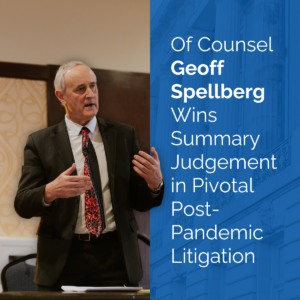 Renne Public Law Group (RPLG) Of Counsel Geoff Spellberg, who represented both agencies, successfully argued that vaccine mandates implemented during the COVID-19 pandemic were essential public health measures designed to protect patients, staff and the broader community. The two cases involved a cohort of approximately 40 plaintiffs who alleged religious discrimination after being excluded from the workplace for refusing vaccinations.
A pivotal moment in post-pandemic litigation, the victories substantiate Geoff’s expertise. In June 2024, he successfully represented Monterey County in a lawsuit brought by employees regarding a COVID-19 vaccine mandate. After nine days of trial, the plaintiffs voluntarily dismissed the case, handing the County a decisive victory.
“There was a huge concern among clients and insurance carriers that religious discrimination cases were going to be like asbestos cases: a massive, uncontrolled wave of litigation,” he said. “RPLG’s aggressiveness in bringing these motions and winning on behalf of our clients helps turn that tide.”
The successful defense relied on a creative application of Government Code section 855.4, which provides immunity for discretionary acts related to the prevention of disease. To secure the wins, Geoff applied legal principles from a school district case, Allos v. Poway Unified School District. By translating the principles to the healthcare context, they argued that public health immunity takes precedence over claims brought under the Fair Employment and Housing Act.
“We think this will be the first published decision in the state that has used this defense in public agency cases involving religious discrimination arguments,” said Geoff. “RPLG is ahead of the curve, making law in this new area of litigation. It shows that our firm is willing to think outside the box and look for solutions — not just settlements — for brand new litigation problems.”
The rulings have significant implications for public agencies across California, particularly those facing volatile employee issues arising from the pandemic. Geoff said that the pandemic created an unusual situation where individuals often sought exemptions by cloaking personal concerns in a “religious patina.” Without the protection of statutory immunity, the ability of public officials to respond to future emergencies, such as a measles outbreak, would be compromised by the fear of litigation over discretionary health decisions.

“The idea is to immunize public health decisions to assure that public health leadership isn’t afraid to step up and do the right thing and protect people,” said Geoff. “The ability to protect the public trumps even constitutional rights in times of emergency.”
RPLG’s commitment to this work reflects its broader mission of serving the public interest, even when the legal road is difficult. Geoff credits the firm’s structure and culture for enabling it to take on complex, high-stakes cases that other firms might avoid. “RPLG is completely willing and devoted to doing the right thing by public entities.” He also highlighted the contributions of Associate Mauricio Grande and the firm’s staff. “Mauricio, one of our top associates, did a lot of the legal work, and Estelle Franklin and Bobette Bramer really knocked themselves out to support the litigation efforts.”
As the decisions move toward the appellate stage, the impact of RPLG’s strategy can already be seen in other venues, including a pending case with the East Bay Regional Parks where courts have indicated similar favor toward this defense. For city managers and health administrators, the takeaway is clear: RPLG remains dedicated to finding creative legal arguments that protect the autonomy and fiscal health of those who serve the public.
“For the safety of their communities, it was critical for public employers to implement various mandates around COVID. Many employees who refused to abide by the protocols have sued, and there have been big judgments in the area,” said Managing Partner Jon Holtzman. “Geoff has carved out a niche in protecting public agencies’ rights to prioritize community health over individual employment grievances.”
Copies of the rulings may be found here:
RPLG practices throughout California, advising and advocating for public agencies and nonprofits, providing courageous, creative and responsive solutions.