




 The California Special Districts Association (CSDA) along with the League of California Cities, California State Association of Counties and government agencies across the state today filed comments with the California Air Resources Board (CARB) expressing disappointment and concern over cost and public safety issues in CARB’s latest, revised version of the Advanced Clean Fleets (ACF) regulatory language.
“Despite repeated warnings from cities, counties, special districts, utilities and emergency service providers, CARB continues to advance a framework that places regulatory compliance ahead of operational readiness during disasters and public emergencies,” said Neil McCormick, CSDA’s Chief Executive Officer. “Climate goals and public safety are not mutually exclusive, yet these requirements continue to overlook operational realities faced by public agencies responsible for protecting lives, maintaining critical infrastructure and responding to disasters.”
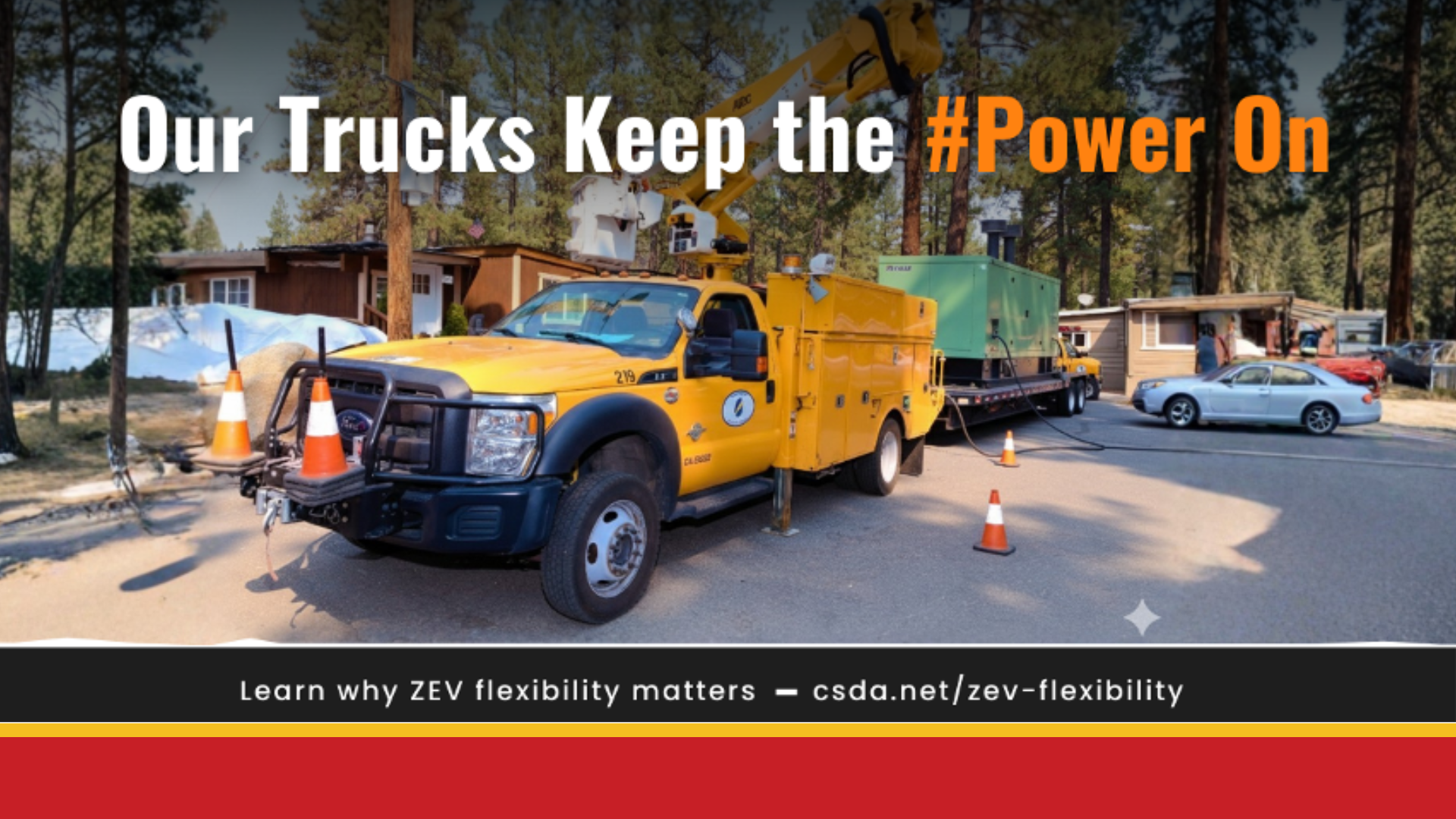
CARB’s mandate requires public agencies to transition to zero-emission vehicles (ZEV) by 2030 despite the lack of infrastructure or vehicles on the market that can serve and protect the public in emergencies. Fire trucks, ambulances and police cars are currently exempt from CARB’s mandate, however there are wide variety of support vehicles needed in emergencies – especially in power outages – that are not.
On June 1, CARB published a second 15-Day Comment Period set of amendments to its ACF regulations mandating state and local governments transition medium-duty and heavy-duty vehicle fleets to ZEV. These amendments still do not address CSDA’s call for exempting vehicles that support emergency response.
“A vehicle towing a generator to power a well or a water tender truck may not look like a firetruck, but they are just as essential to emergency response as the fire engines they replenish,” McCormick said. “As California leads the nation in climate policy, we must ensure progress toward a cleaner future doesn’t come at the expense of public safety,”
Compounding the need for flexibility is the fact that natural disaster events can last for days or weeks, and power may be unavailable; and the fact that the vehicles essential to supporting emergency equipment have absolutely no counterpart – in price or capability – in the ZEV marketplace. Even if they did, California lacks the ZEV infrastructure necessary for the ongoing operational reliability local agencies need.
Another concern raised by local agencies is that, while this most recent round of amendments is intended by CARB to clarify if and when private company’s vehicles under contract with a state or local government are considered part of the “fleet” for compliance with the ACF regulations, they in fact only create more confusion, and will drive up costs.
For example, guidance released by CARB shortly following the release of the latest draft regulation states that “Private Fleets are not subject to the ACF State and local government regulations.” However, this same guidance says the regulations apply to “functions carried out through contractual arrangements,” which, according to CSDA, is so vague that it could include any contract absent clarification..
Public agencies are using this guidance language to highlight concerns that CARB is trying to extend the ACF regulations beyond state and local government fleets to private entities contracted by public agencies, regardless of the nature of the work being performed.
“CARB is attempting to regulate entities that were never represented as part of the state and local government fleet provisions,” McCormick said. “The practical effect is a significant cost shift onto local governments and ratepayers without corresponding statutory authority, demonstrated need, or available vehicle technology.”
CARB’s ZEV mandate was unveiled in 2023 in response to state laws calling for California to meet aggressive carbon reduction goals by 2045. While these goals have broad public support, California voters actually prefer the flexibility these local agencies are urging.
A recent statewide CSDA survey of voters asked this very question. The response was nearly uniform regardless of political preference, with more than 70 percent of Democratic, nonpartisan, and Republican voters respectively all in agreement that these exemptions would be a good idea.
Local leaders are requesting the state amend the regulation to provide more clarity on contracted private fleets and to exempt local government vehicles used for water utility, flood protection, sewer utility, electric utility, fire prevention, fire protection, search and rescue, and disease and vector control. The 15-day public comment period conclude on June 16, after which CARB may consider making further amendments to its ZEV rule. More information on the need for flexibility in CARB’s ZEV mandate is available here.
About CSDA: The California Special Districts Association (CSDA) represents more than 1,000 special districts—local public agencies that provide essential services throughout California. These local service specialists provide irrigation, water, sanitation, fire protection, open space, park and recreation, cemetery, electricity, library, resource conservation, port and harbor, healthcare, and other community services that in some way benefit California’s 39 million residents. Special districts are critical to California’s economy and infrastructure and operate on the front lines of addressing statewide challenges at the local level. Learn more at csda.net