






 During the week of January 12, CALED CEO & President Gurbax Sahota traveled to Washington, D.C. to meet with the following federal offices regarding evolving economic development resources: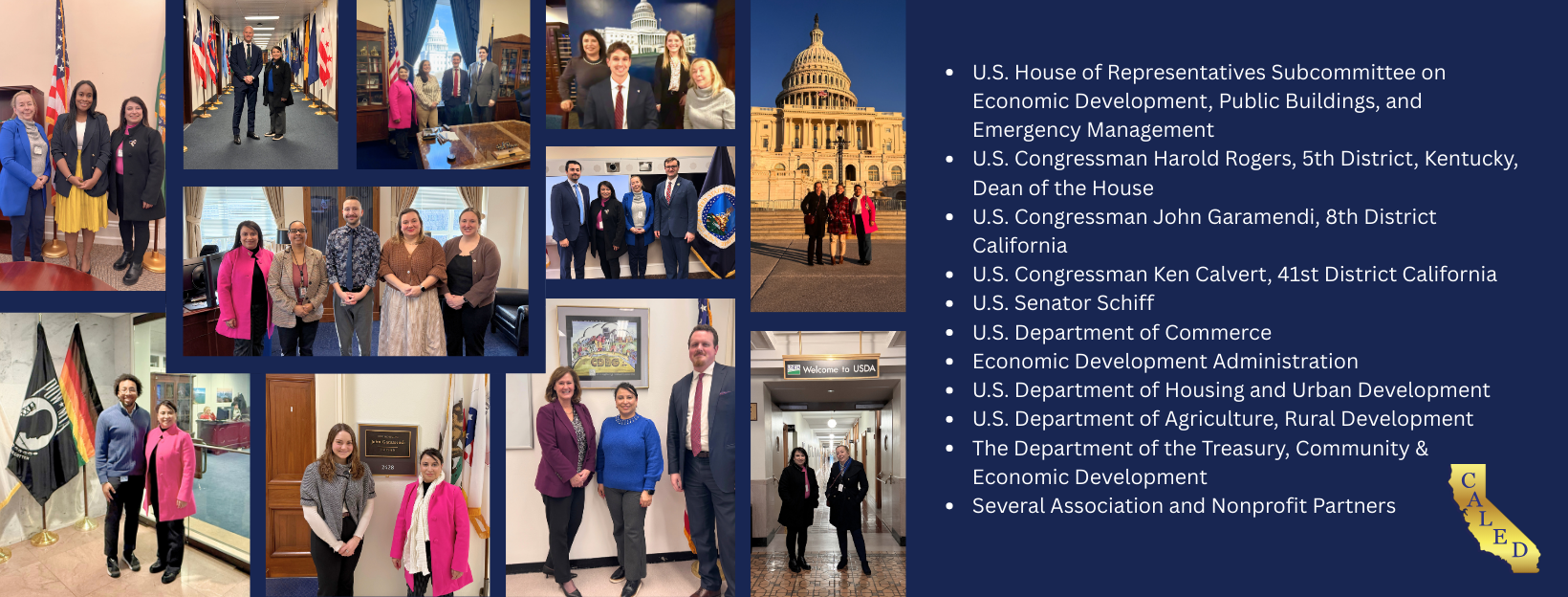
CALED’s discussions in Washington, D.C. emphasized practical, actionable recommendations that would strengthen capacity at the local level, expand access to critical resources and support communities of all sizes as they adapt to economic change. Key discussion points at these meetings included:
- Economic Development Administration (EDA)
This agency is the strongest partner locals have for economic development. The technical assistance and high standards for project delivery make EDA uniquely effective in moving the needle.- Recommendation:
- Offer a newly created Economic Adjustment Assistance program that accounts for AI and other changes in the environment, and fund regional representatives for technical support. This includes a travel budget to reach grantees and establish relationships with local governments.
- Recommendation:
- USDA Rural Development (USDA-RD)
This department is a lifeline for many rural communities that do not have staff, capacity, or resources to help businesses and create diverse job opportunities for their residents.- Recommendations:
- Hire staff or contract with partners to train locals on project finance, with proactive outreach to communities that could benefit from USDA-RD’s services.
- Hire staff or contract with partners to work with eligible Qualified Opportunity Zone (OZ) rural cities/counties to benefit from the program. Even if a governor does not select an eligible rural area as a designated OZ, help these communities develop plans for investment and economic development.
- Recommendations:
- Community Development Block Grant (CDBG) Program
This is the most flexible program for delivering community and economic development projects.
- Recommendation:
- Allow non-entitlement communities to bypass state interference/bureaucracy with a direct allocation. Contiguous jurisdictions that partner on CDBG activities should also be allowed to receive a direct allocation.
- Recommendation:
- Manufacturing Extension Partnership (MEP) or Successor Program
California is the largest manufacturing state in the U.S. by number of manufacturers and jobs. Small and mid-sized manufacturers (250 employees or less) depend on access to specialized advice and skills to grow and thrive. The MEP program is a critical resource offering tailored solutions to business challenges including: developing strategies for continuous improvement, increasing cybersecurity, improving efficiencies with technology including AI, scaling production, marketing, and problem solving.- Recommendations:
- Allow California to apply for a new MEP designee to provide technical assistance to small manufacturers while the program is in flux.
- Include a CALED representative or representation from a statewide manufacturing organization in leadership discussions on reimagining support for small manufacturers.
- Recommendations:
- Industrial Development Bonds (IDBs)
This is an effective, but underutilized tool that enables manufacturers to expand facilities and buy equipment in the U.S.- Recommendations:
- Expand the definition of “manufacturing facility” to include all manufacturing types.
- Eliminate restrictions on “directly related and ancillary facilities.”
- Increase maximum IDB size limit from $10 million to $30 million, indexed to inflation.
- Require states to set aside 10% of annual federal tax credit allocations for IDBs for the first six months of the year.
- Recommendations:
Overall, these meetings reinforced the importance of strong federal-local partnerships and the need to modernize economic development tools to reflect today’s realities. CALED remains committed to advocating for policies that empower local economic developers, foster resilient communities and help businesses thrive across California and beyond.
Thank you to Smith Garson for their assistance with these meetings.