




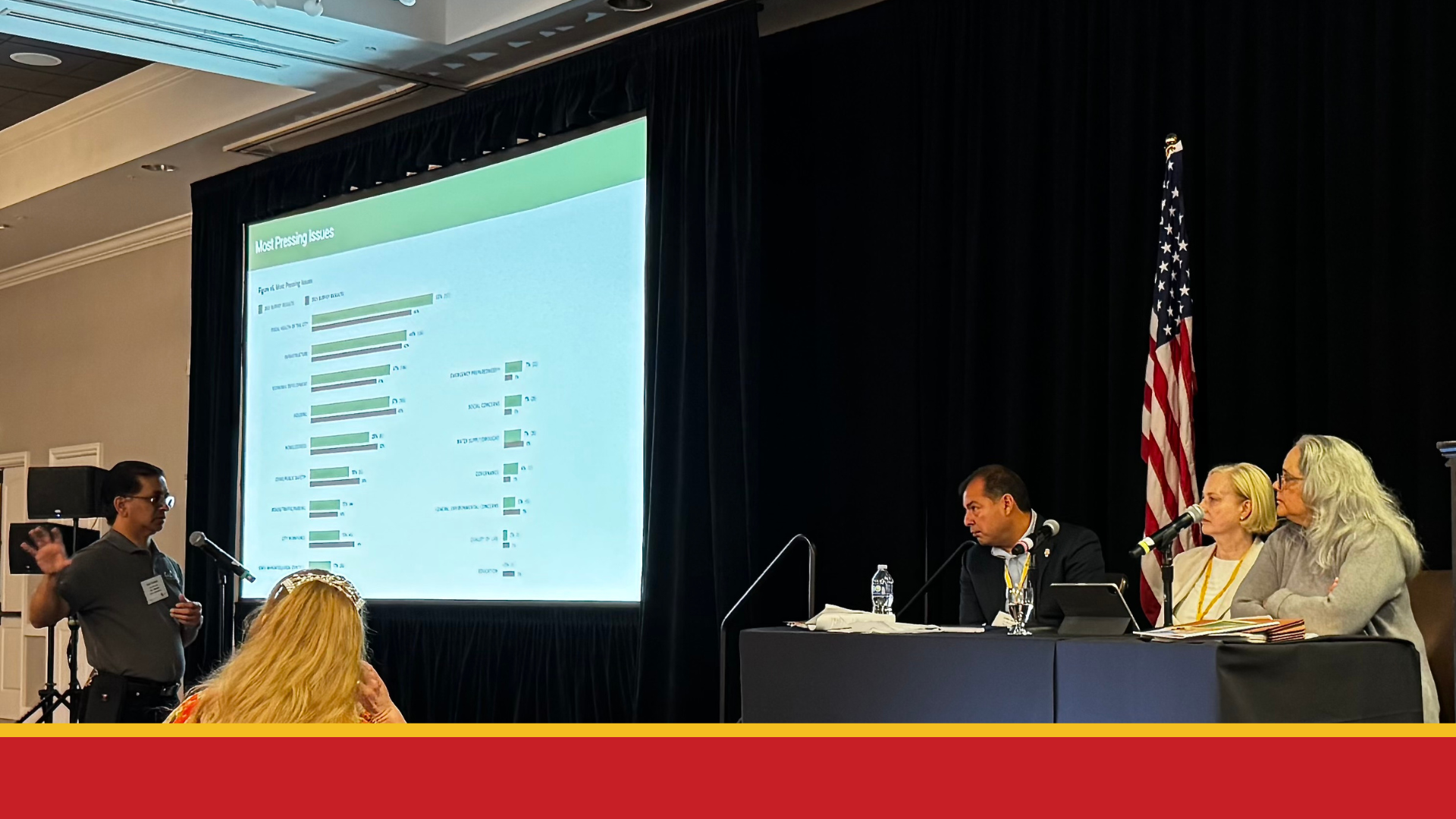

The Rose Institute of State and Local Government at Claremont McKenna College, in partnership with the California City Management Foundation (CCMF), presented the 2025 California City Manager Survey: A Profile of the Profession at the League of California Cities (LOCC) 2026 City Manager Conference in Napa, California on February 13.
This Survey, which provides a comprehensive overview of city managers in California, seeks to promote a greater understanding of this influential group of public officials. Tripepi Smith Talent Solutions and the California Joint Powers Insurance Authority contributed additional support.
The Survey presents data on the demographics, average tenure, educational attainment and employment history of California’s city managers. The survey also reports city managers’ opinions on the most pressing issues their communities face.
Rose Institute Assistant Director Bipasa Nadon presented the report at the conference. “City managers are critical to the operation of local government in California,” she said. “We are pleased to work with CCMF to learn more about and spotlight this profession.”
CCMF Vice President and Burbank City Manager Justin Hess, and Karen Pinkos, city manager of the City of El Cerrito, joined Nadon in discussing the survey’s findings.
The survey was conducted by Rose Institute staff and student researchers. It includes three primary sections: demographic profile, employment profile and city profile.
As envisioned by the creators of their profession in the early twentieth century, California’s city managers are highly professionalized. A large majority have earned advanced degrees in fields such as public policy, public administration and business administration. City managers have received their highest degrees from a range of colleges and universities, led by the University of Southern California (30), Cal State Long Beach (24) and San Jose State University (13). Most city managers also have extensive experience in local government before attaining their office.
Among other findings, the report indicates approximately one-fourth (24%) of responding city managers are women, which is slightly higher than the national average. In the past half century, the percentage of women in chief administrator roles has grown nationwide. The International City Managers Association (ICMA) reported that 23% of city managers in the United States were women in 2024, up from only 1% in the mid-1970s.
Meanwhile, the Survey indicated incremental growth in the profession’s racial and ethnic diversity compared to 2023. Although approximately 70% of respondents identified as White, the 2025 Survey indicated a small increase in the percentage of respondents reporting some other race.

The new Survey also shows that the large majority of California city managers (77%) are in their 40s and 50s. Forty-one percent of respondents listed 51-60 as their age, and another 36% listed 41-50. The results indicate that younger city managers tend to serve in small cities (less than or equal to 35,000 in population). Managers in the 60+ age bracket were also more likely to serve in small or medium cities. Meanwhile, managers in large cities (population of 75,001-200,000) and very large cities (population of 200,001+) are largely in the 41-50 and 51-60 age groups.
In the Survey, city managers ranked fiscal health, infrastructure, economic development, housing and homelessness as the five most pressing issues their cities face.
To view the 2025 California City Manager Survey: A Profile of the Profession, visit https://www.cacitymanagers.org/wp-content/uploads/2025/06/2025-CCMF-
Report.pdf or https://www.cmc.edu/rose-institute/2025-california-city-managers-survey
About the Rose Institute of State and Local Government
The Rose Institute of State and Local Government was founded at Claremont McKenna College in 1973. A leading resource for information on California state and local governments, the Rose Institute pursues research projects on elections, government institutions, public opinion and policy. It also maintains extensive state and local demographic, economic and political databases. For more than 50 years, the Institute has fulfilled its mission to enhance the education of students at CMC, produce high quality research and promote public understanding on issues of state and local government, politics and policy, with an emphasis on California. For more information, visit https://roseinstitute.cmc.edu/.
About Claremont McKenna College
Claremont McKenna College is a private, 1,300-student residential liberal arts college located east of Los Angeles in Southern California. Since 1946, the College’s mission has been to prepare students for thoughtful and productive lives and responsible leadership in business, government and the professions. Renowned for its Open Academy commitments to freedom of expression, viewpoint diversity and constructive dialogue, as well as expertise in economics and government, Claremont McKenna also features an accomplished faculty of scholars and committed teachers in the
humanities, sciences and social sciences. Students are drawn to the College’s unparalleled offerings, including: 11 research institutes and centers; the ability to conduct research one-on-one with faculty; and access to leaders, artists and visionaries who engage with students at the Marian Miner Cook Athenaeum. Claremont McKenna is a member of The Claremont Colleges. For more information, visit cmc.edu.